
So, Which Size Actually Makes Sense for Your Business?
Picking a TV for your office feels like a five-minute decision until you’re staring at two boxes and a price gap. I’ve watched owners overspend on screens that sulk in a corner and squeeze a 55 into a lobby that needed a 65. Neither mistake is fun to reverse.
This guide walks through the 55-Inch vs 65-Inch VU Masterpiece Frame TV decision the way a business owner should: space, spend, and what you get back for it. Your office isn’t a living room, and this screen sits in front of clients, so the usual home-theater advice only gets you halfway.
Why This Choice Matters More Than It Looks
A Frame-style TV does two jobs. It plays content when you need it, and it shows artwork when you don’t. In a reception area or boardroom, that means it works around the clock, not just during meetings.
So you’re really asking what a wall-mounted screen should do for you:
- Make a first impression before anyone says hello
- Support presentations without squinting or craning
- Fill dead wall space with something better than a blank rectangle
- Look premium without needing an interior designer
Size shapes all four.
Room Size: Start Here, Not With the Price Tag
Most people compare prices first. I’d flip it. A TV that’s wrong for the room is wasted money at any price.
The 55 inch vs 65 inch TV question usually comes down to viewing distance:
- 55-inch: Works well when viewers sit roughly 5 to 8 feet away. Think small cabins, compact meeting rooms, and a director’s private office.
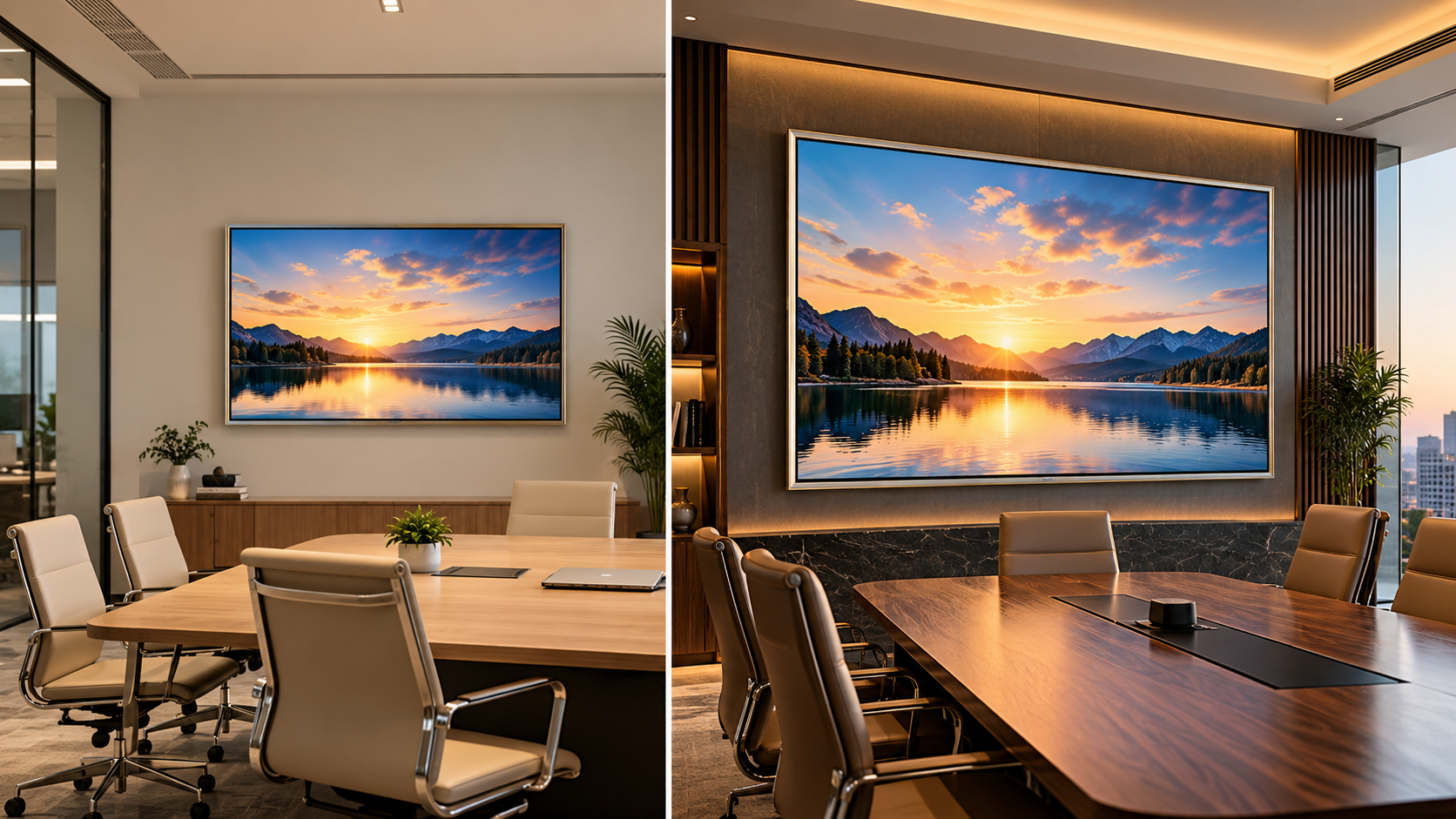
- 65-inch: Suits 7 to 11 feet. Think reception areas, mid-size conference rooms, and open-plan floors where people watch from across the room.
Here’s a quick test. Stand where your furthest viewer sits, then picture a presentation slide on that wall. If you’d squint at the footnotes, go bigger. If the screen would swallow the wall, stay smaller.
Spend vs. Return: The Money Side of the Decision
I’ll keep this practical, because a VU Masterpiece Frame TV price comparison should be about value, not just the sticker.
The 65-inch costs more up front, and the gap is usually noticeable, though not huge. I won’t quote exact figures here because pricing shifts with offers and retailers, so check current listings before you decide. What matters is how to read the gap:
- Cost per viewer: If five people watch regularly, a bigger screen often serves them better than two small ones.
- Cost of regret: Replacing an undersized TV in eight months costs far more than the original price difference.
- Cost of overkill: A 65-inch in a small room can feel overwhelming and make the space look cramped.
My view: the cheaper TV isn’t automatically the smarter buy, and neither is the pricier one. The right size is the one that matches how your room is used.
55-Inch: Where It Wins
The smaller model gets underestimated. It earns its spot when:
- Budget is tight. You keep the Frame look and the art-mode feel at a lower entry cost.
- Space is limited. A 55 sits neatly on a narrow wall or beside a window.
- Viewing is close. One-on-one meetings and small huddles don’t need a giant panel.
- You’re outfitting multiple rooms. Buying several 55s often costs less than a few 65s, and the look stays consistent across offices.
If you run a growing team with several small rooms, this is the practical pick.
65-Inch: Where It Wins
The bigger model makes sense when the screen has work to do:
- Reception and lobbies. A large Frame displaying art or your brand visuals says a lot in a few seconds.
- Boardrooms. Charts, spreadsheets, and dashboards stay readable from the back of the table.
- Open offices. One big screen can serve a wide area.
- Client-facing spaces. Size reads as confidence. People notice it, and they remember it.
If clients walk past this TV daily, I’d lean 65. A better first impression is hard to measure, but it’s real.
Quick Comparison at a Glance
For anyone scanning, here’s the VU Masterpiece Frame TV 55 inch vs 65 inch breakdown in short form:
- Best for small rooms: 55-inch
- Best for large rooms: 65-inch
- Lower upfront spend: 55-inch
- Stronger visual impact: 65-inch
- Better for presentations to groups: 65-inch
- Easier to place across several offices: 55-inch
- Higher risk of outgrowing: 55-inch
- Higher risk of overpowering the room: 65-inch
Mistakes I See Business Owners Make
- Choosing by price alone. Saving a little now and replacing later is a bad trade.
- Ignoring the wall. Measure the width, check for sockets and switches, and plan the cable route before ordering.
- Forgetting the lighting. Glare from big windows can hurt visibility more than screen size helps.
- Skipping the mounting plan. A Frame-style TV looks best when it sits flush. Budget for proper wall mounting and cable concealment.
- Never testing the content. Check how your usual files, slides, and art actually look on the screen.
A Simple Way to Decide
Run through these in order:
- Measure the viewing distance from the furthest seat.
- Count the regular viewers. More than six usually points to 65.
- Note the room’s purpose. Client-facing leans 65, internal and private leans 55.
- Set a ceiling. If the budget is fixed, pick the bigger size you can comfortably afford, not the biggest one you can stretch to.
- Think two years ahead. If the team or the space is growing, size up.
My Honest Verdict
If I had to put it in one line: choose the 55 for private, compact, or budget-driven spaces, and choose the 65 for anywhere that’s seen, shared, or presented in.
For most growing companies, the 55-Inch vs 65-Inch VU Masterpiece Frame TV debate settles itself once you measure the room. The numbers on the box matter less than the distance between the screen and the people watching it.
Before you buy, run the VU Masterpiece Frame TV price comparison across a few sellers, confirm the latest specs, and ask about installation. A good screen badly mounted still looks like a mistake.
Final Thought
A TV isn’t a cost center when it’s the right one. It’s part of how your business looks and works day to day. Make the 55-Inch vs 65-Inch VU Masterpiece Frame TV call based on your space and your audience, and you won’t have to make it twice.